Talk and Visit by Soile Nymark
We are delighted to have as next invited “Visiting Researcher” Soile Nymark from Tampere University in Finland. She will hold on October 28 at 9 a.m. in the HNO Lecture Hall in Tübingen, a presentation on: Biophysical signaling in the retinal pigment epithelium regulates photoreceptor renewal.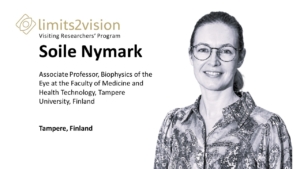
Soile Nymark is an Associate Professor at the Faculty of Medicine and Health Technology, at Tampere University, Finland. She received her PhD at Aalto University, Finland, studying adaptation mechanisms in retinal photoreceptors. She did her post-doctoral training at Boston University School of Medicine, USA, focusing on the retinal visual cycle. After returning to Finland, Dr. Nymark shifted her attention to the retinal pigment epithelium (RPE), the key retinal maintenance tissue, and began investigating its ion channel machinery. In 2016, Dr. Nymark started her own research group with the goal of understanding the multiple interactions between the retina and the RPE focusing on RPE ion channelome and related diseases. Her expertise covers electroretinography, single cell electrophysiology, calcium imaging, live-cell fluorescence microscopy, and different model systems including stem cell derived in vitro models, mice and zebrafish.
In her talk, she will highlight how the efficient uptake and clearance of aged photoreceptor outer segment tips are critical for photoreceptor health, with impairments linked to retinal degenerative diseases. This process is precisely regulated and relies on the intricate interaction between the retina and the RPE. Decades of research have illuminated this captivating and dynamic process, though its complex physiological regulation remains incompletely understood. Recent studies suggest that, beyond biochemical factors, biophysical players also have a critical role in governing the molecular mechanisms underlying outer segment uptake. The presentation discusses the latest findings on the biophysical determinants of the process, with particular emphasis on ionic signaling, and cellular mechanics of the RPE5. Additionally, it introduces emerging approaches aimed at exploring this relatively under-investigated aspect of RPE physiology.
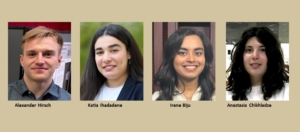
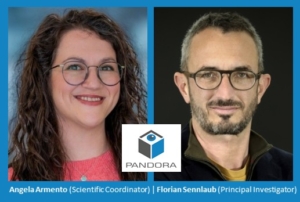 tal research and clinical translation.
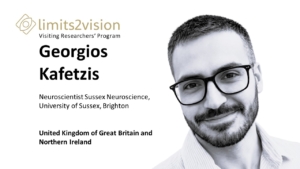 Within the field of sensory neuroscience, his work addresses fundamental questions about how neural circuits balance information processing, efficiency and biological constraints — questions that closely align with the scientific vision of limits2vision. By investigating retinal computation across species and evolutionary timescales, Georgios Kafetzis contributes to a deeper understanding of how the visual system has evolved to optimize information transmission under energetic and structural limitations.
 will also participate in the International Scientific Meeting “Understand, Preserve & Restore Vision”, taking place at the Institut de la Vision from 5–7 October 2026. Together, these events will provide valuable opportunities to connect research groups, exchange expertise, and foster new collaborations.